
Art Installations Near Me: A 2026 Discovery Guide
Table of Contents
Why Art Installations Near Me Are Worth Seeking Out
How to Find Public Art Near Me Using Maps and Local Resources
Using Location-Aware Search and Distance Filters
Regional Arts Councils and Municipal Art Registries
Outdoor Art Installations: What to Expect and Where to Look
The Visit-Details Checklist Most Guides Skip
Where Outdoor Installations Actually Sit
Indoor vs. Outdoor and Weather Suitability
Build a Short Route, Not a Long List
Immersive Art Experiences Near Me: Multi-Sensory and Experiential
Free Art Installations Near Me: Accessible and Family-Friendly Options
Accessibility Varies More Than Cost Does
Family-Friendly Means More Than Free
Current Status and Seasonal Availability
Indoor vs Outdoor Installations: Weather, Accessibility, and Timing
What to Look for When Visiting an Art Installation
Conclusion
Frequently Asked Questions
Last Updated: October 7, 2026
Why Art Installations Near Me Are Worth Seeking Out
Art installations near me are closer than most people think, and they change how a neighborhood feels.
A quick definition: public art is any artwork placed in a shared space, such as a street, plaza, park, or transit station, where anyone can encounter it without buying a ticket.
The search itself has gotten easier. The National Endowment for the Arts public art resources explain how local agencies fund and document much of this work.
Below, we'll show you exactly how to find installations near you, whether you have an afternoon or a full weekend.
How to Find Public Art Near Me Using Maps and Local Resources
Finding public art near me starts with two tools: a location-aware map search and a local arts registry. Both are free, and together they cover most of what's out there.
Using Location-Aware Search and Distance Filters
Open your maps app and search for "public art," "sculpture," or "mural" instead of the full keyword phrase. Then apply a distance filter. A 2-mile radius works well in a dense city; widen it to 10 miles in a suburb or rural area.
A common mistake is searching only for "art museum." Most installations are not in museums. They sit in parks, outside libraries, along riverfronts, and beside transit stops.
Regional Arts Councils and Municipal Art Registries
Every state has a state arts agency directory, and most cities maintain a public art registry with addresses, artists, and installation dates. These registries are the most reliable source because someone verifies the location.
Start with your city's arts commission page, then check the county and state level. Smaller towns often list their works through a regional council rather than a dedicated office.
Pro Tip Call the local arts council before a long drive. Registries go stale, and staff usually know which pieces were recently removed for repair, which is information no map app carries.
Outdoor Art Installations: What to Expect and Where to Look
Outdoor art installations are the easiest to visit and the hardest to plan around, because weather and daylight decide the experience. Expect no admission fee at most sites, but also expect no staff, no posted hours, and occasionally no signage. The fix is to gather the practical details before you leave, not after you arrive.

The Visit-Details Checklist Most Guides Skip
Before any outdoor visit, confirm six things. Competitors list destinations; this is the layer that makes a destination usable.
Address and nearest cross street. Map pins for sculptures are frequently off by a block, especially in parks and on campuses.
Hours or daylight limits. Most outdoor works are technically accessible 24/7, but many parks close gates at dusk or have posted dawn-to-dusk rules.
Admission. Municipal and campus works are almost always free; sculpture parks tied to a museum may charge or request a donation.
Parking. Look for a named lot or garage rather than "street parking," which may be permit-only during weekday business hours.
Accessibility. Check for paved paths, curb cuts, and benches. Improvised sites often lack all three.
Visit duration. A single plaza sculpture is a 10-minute stop; a sculpture park with a loop trail is a 60-to-90-minute outing.
Where Outdoor Installations Actually Sit
Look in predictable places first, and note what each type typically offers:
Sculpture parks and botanical gardens, the most reliable for accessibility, restrooms, and mapped paths; often the longest visit duration.
Plaza and civic center forecourts, short, walkable stops near transit; minimal seating.
University campuses, significant collections, usually free, but parking rules tighten on class days.
Riverfronts, trails, and converted rail lines, linear routes where the walk itself is part of the experience; surfaces vary from paved to gravel.
Transit stations and airport concourses, free and weatherproof, but only accessible to ticketed riders or during operating hours.
Large-scale artwork in these settings is built to survive weather, so materials tend toward steel, stone, bronze, and concrete. That durability is also why outdoor pieces stay in place for years, while temporary installations rotate out.
Indoor vs. Outdoor and Weather Suitability
Outdoor works are seasonal in ways that aren't always obvious. Fountains are drained before the first freeze, some paths close for winter, and temporary pieces come down on a published schedule. A simple rule: label each candidate as outdoor, covered, or indoor before you build a route. If the forecast turns, you can swap an outdoor stop for a covered or indoor one without scrapping the day.
Build a Short Route, Not a Long List
A common pattern among frequent visitors is to plan two or three nearby stops rather than one distant destination. Cluster by neighborhood, order them by walking distance, and check current status the week you go. That turns a single sculpture into a half-day that holds up even if one piece is temporarily gone.
Key Takeaway Outdoor installations are free and flexible, but only if you verify address, hours, parking, accessibility, and current status first. Two or three clustered stops beat one far-off destination.
Immersive Art Experiences Near Me: Multi-Sensory and Experiential
Immersive art experiences near me differ from traditional installations in one key way: you move through the work rather than stand in front of it. Projection rooms, mirrored environments, and sound-and-light rooms are the common formats.
These shows usually require timed tickets, and they sell out on weekends. Book midweek if your schedule allows. The American Alliance of Museums trends reporting has noted how strongly experiential formats have reshaped attendance patterns at cultural venues.
What most guides miss is the pacing. An immersive room rewards a slow second pass. Walk through once to orient yourself, then stand still and let the room do the work.
Free Art Installations Near Me: Accessible and Family-Friendly Options
Free art installations near me fall into a few reliable categories, and the useful comparison isn't just cost, it's whether the site works for your group, your mobility needs, and the season. The table below adds the columns most guides leave out.
Option | Typical Cost | Best For | Accessibility | Family-Friendly? | Watch Out For |
Municipal public art | Free | Everyday walks, quick visits | Varies; plazas usually paved | Yes, with supervision | No posted hours; no restrooms |
Sculpture parks | Free or low donation | Longer outings, strollers | Usually paved paths and benches | Yes | Limited shade; seasonal closures |
Transit and campus art | Free | Commuters, lunch breaks | Step-free in most modern stations | Older kids | Busy at peak times; rider-only access |
Immersive ticketed shows | Paid | Date nights, special trips | Varies; confirm before booking | Often not for young children | Crowds, timed entry, sellouts |
Accessibility Varies More Than Cost Does
Cost is easy to predict; accessibility is not. Paved paths, curb cuts, and benches are common in parks but rare at improvised sites. Before you go, ask three questions: Is the path paved or gravel? Is there a step-free entrance or route? Are there benches or rest areas along the way? Call ahead if anyone in your group uses a wheelchair, uses a stroller, or has trouble with uneven ground.
Family-Friendly Means More Than Free
A free site isn't automatically good for kids. The practical factors are restrooms, shade, seating, and how close the artwork sits to traffic or water. Sculpture parks tend to score best because they combine open space with mapped paths. Transit and campus installations can work for older children but may be crowded or rider-only during peak hours.
Current Status and Seasonal Availability
Temporary exhibits and closures make any list stale, so verify status the week you plan to go, not the month before. Three checks cover most cases:
The venue's own page for closures, repair, or removal notices.
The city or county arts registry for installation and de-installation dates.
A quick phone call to the parks department or arts council for anything not posted online.
Watch Out Do not assume a sculpture is climbable. Many large works are welded assemblies with sharp edges and no structural rating for weight, and parks post prohibitions for good reason. A photo from the path is the safe choice.
Key Takeaway Free is the starting point, not the whole decision. Compare accessibility, family suitability, and current status before you commit to a route, and re-check status the week you go.
Indoor vs Outdoor Installations: Weather, Accessibility, and Timing
Indoor versus outdoor is the decision that shapes your whole visit. Indoor installations give you climate control, predictable hours, and step-free access. Outdoor installations give you scale, natural light, and no schedule at all.
Choose indoor when:
Temperatures are extreme or storms are forecast
Someone in your group needs accessible, level flooring
You want guaranteed opening hours
Choose outdoor when:
You want to combine art with a walk or a meal
You are visiting early morning or near sunset, when light changes the work
You need something free and unstructured
Seasonal availability matters too. Fountains shut off, temporary pieces come down, and some sites close paths for winter. Check the venue's current status the week you plan to go, not the month before.
What to Look for When Visiting an Art Installation
A good visit is mostly about attention, and a few habits make the difference between glancing and actually seeing.
Walk the full perimeter. Many works change completely from the back or side.
Read the plaque. Artist, title, year, and materials tell you what the piece is responding to.
Note the light. Morning and late afternoon reveal surface and shadow that midday flattens.
Check the ground. Site-specific work often responds to the pavement, planting, or water nearby.
Look for the map. Some installations are built around movement through a place, and the route is the artwork.
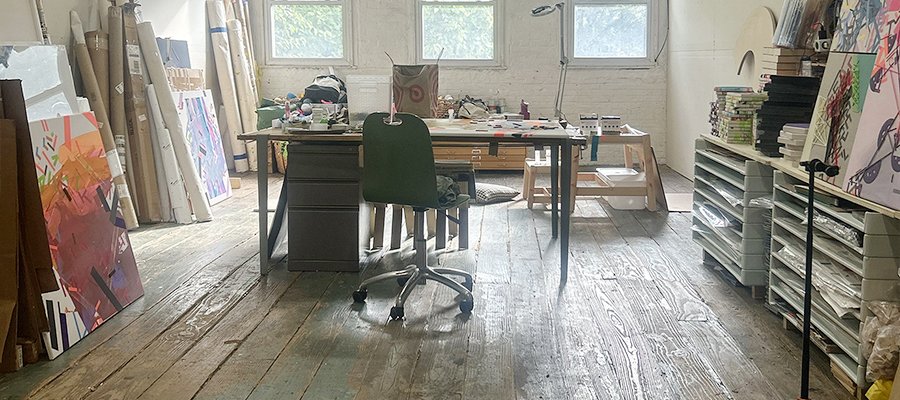
That last point is where HALABURDA's practice sits. Psychogeographical mapping treats a walk through a place as the raw material, then translates the invisible interactions of environment, mood, and memory into color and geometry.
The real difference between a piece that stays with you and one you forget comes down to whether it maps something you already sensed about a place. When it does, you recognize it before you can explain it.
Conclusion
Finding art installations near you takes two searches and one phone call, and the payoff is a neighborhood you read differently. Start with your city's public art registry, filter by distance, and check current status before you go.
For collectors and designers who want work that carries a sense of place into a room, HALABURDA offers abstract paintings, works on paper, and installations built through psychogeographical mapping, with an exhibition history spanning New York, Paris, Santa Fe, and Basel. Explore the practice and see how a location becomes a composition.
Frequently Asked Questions
How much do art installations cost?
Costs vary widely based on scale, materials, and whether the piece is temporary or permanent. Public installations are often funded through municipal arts budgets or grants, while private commissions depend on the artist's fees and fabrication expenses. For specific pricing on HALABURDA's work, contact the studio directly. Many outdoor and public art installations are free to visit, though some immersive experiences charge admission.
What is the difference between an art installation and a sculpture?
A sculpture is typically a standalone three-dimensional object, while an art installation transforms an entire space or environment. Installations often incorporate multiple elements, light, sound, or interactive components, and they are designed to be experienced rather than just viewed. Sculptures can be part of an installation, but installations create a broader spatial and sensory experience that surrounds the viewer.
How do I find outdoor art installations nearby?
Start with location-aware searches using distance filters on mapping apps. Check your regional arts council website, municipal public art registries, and local tourism boards. Many cities maintain searchable databases of outdoor art installations, including sculptures, murals, and site-specific works. University campuses and sculpture parks are also reliable sources for open-air art.
What should I look for when visiting an art installation?
Check current status and seasonal availability before you go, since some outdoor installations are temporary or weather-dependent. Look for accessibility information, admission fees, and opening hours. Bring a camera if photography is allowed. Take time to experience the work from multiple angles and consider how the environment interacts with the piece, which is central to site-specific and psychogeographical art.
Start with the free public work in your own city this week. When you are ready to bring that same sense of place into a private or corporate collection, HALABURDA can walk you through the available works and the thinking behind each one.
Order Your Art Today


Comments